Differences in social communication, intense or very specific interests, sensory sensitivities, and struggling with unstructured social situations—these are just a few common signs of autism in teenagers.
These symptoms commonly appear alongside autism or other symptoms that may not have been as prevalent during younger years. This is part of why autism is so often missed or misunderstood during adolescence, especially during teens who are able to socialize easily, but still experience the world differently.
Additionally, research on autistic teenagers has found that certain traits, like differences in facial expressions, are present at different ages, while other traits may change as coping skills and language develop. [1]
If you’re looking for mental health treatment for an autistic teen, a neurodiversity-affirming treatment center can help ensure these differences are understood and supported rather than treated as problems that need to be cured or fixed.
Quick Facts
- Autism in teens often shows up through differences in social communication, and doesn’t always include social withdrawal
- Many autistic teenagers describe their experiences in terms of differences rather than struggles
- Anxiety commonly co-occurs alongside autism, causing it to sometimes be misunderstood and treated as the primary issue
- Autism looks different at different ages, and some traits may become less visible over time, while others (like facial expression patterns) are usually more consistent
- Additional support may be worth considering when these patterns are affecting daily life, school, or relationships
Social and Communication Differences in Autistic Teens
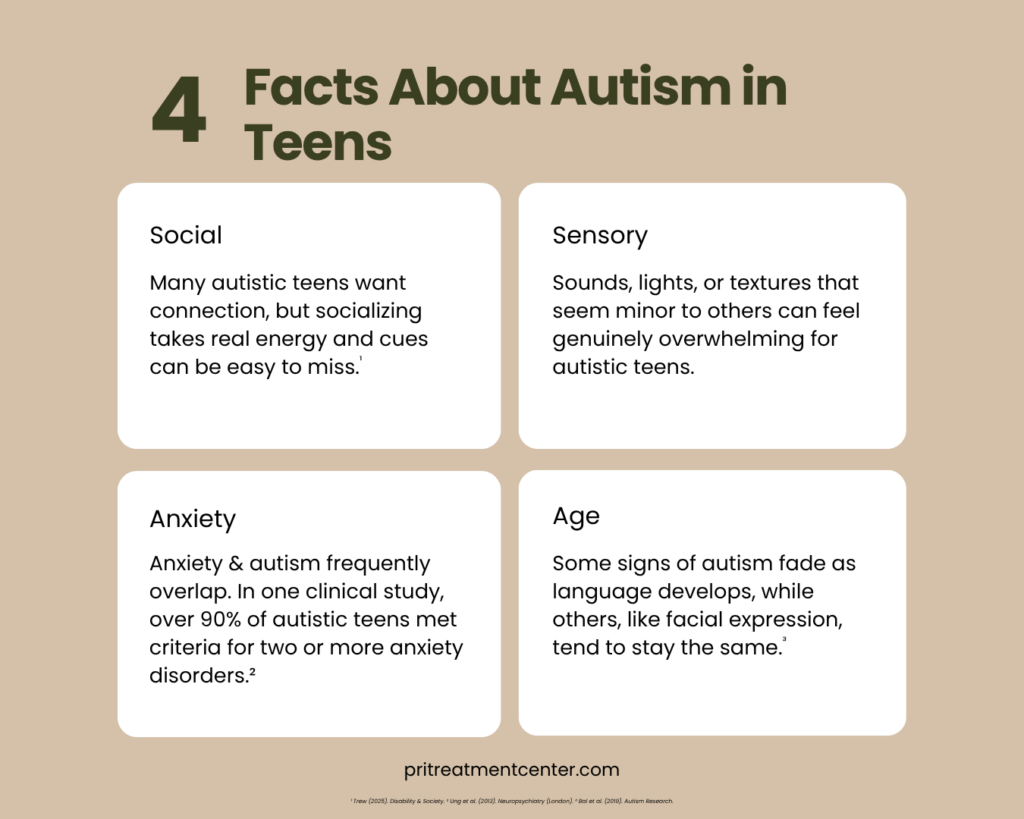
Many autistic teens have described a desire for closeness and connection, while finding socializing to be very exhausting or confusing.
In interviews, many autistic adolescents have a shared experience of needing to “get away” from people after a while—not because they dislike the people they’re with, but because social interactions take real energy. [2]
Some teens have also described not picking up on “unwritten social rules” that seem to come naturally to their peers. [2]
This may look like:
- Speaking for a long time about one specific interest without noticing cues from the listener
- Missing or misreading nonverbal signals like tone or body language
- Feeling drained after group interactions, even when they enjoy the people or activity
- Preferring one-to-one interactions over larger, group settings
The Relationship Between Anxiety & Autism in Teens
Anxiety is one of the most common experiences reported alongside autism in adolescence.
In one clinical sample of high-functioning autistic youth seeking treatment for anxiety, more than 90% of them met criteria for two or more anxiety disorders, most commonly social anxiety and generalized anxiety. [3]
What can make things more confusing is that anxiety and autism symptoms can look very similar on the surface. This can make it harder to determine the main driver for symptoms like avoidance, irritability, or shutdowns.
This overlap between anxiety and autism matters because treating anxiety in an autistic teen looks different than treating anxiety on its own. This requires understanding both what’s causing the teen’s distress and how autism shapes their coping style.
How Autism Can Show Up Differently At Different Ages
Autism looks different at different ages, and the diagnostic markers that would apply to young children simply don’t look the same for teens and adolescents.
So, while a teen may seem to “grow out of” earlier developmental differences, this doesn’t necessarily mean they’ve grown out of autism.
Longitudinal research tracking autistic individuals from age two through nineteen found that many social communication symptoms became less visible over time and as language develops. In contrast, difficulties with facial expression remained consistent over the same period. [1]

How PRI Treatment Center Can Help
For teens whose autism-related differences come along with anxiety, emotional overwhelm, or difficulty functioning day-to-day, structured treatment can help.
PRI Treatment Center’s mental health treatment programs are built with neurodivergent teens in mind. If you’re wondering whether your teen could benefit from additional support, our team can help you understand your options.
Call (858) 914-0335 or let us verify your insurance to understand coverage before you begin treatment.
Frequently Asked Questions
High-functioning autism in teens can involve strong verbal skills alongside differences in social communication, like struggling to read social cues or a strong need for routine. These teens may mask their differences well enough that they go unnoticed until social demands increase during their teenage years.
Stimming is repetitive movements or sounds that help regulate emotion or sensory input. Examples may include hand-flapping, rocking, tapping, or repeating phrases. For many autistic individuals, including teenagers, stimming is a coping tool rather than something that needs to be stopped or corrected.
Listening without trying to "fix" their differences can go a long way. Most autistic teens want to be understood, not corrected. Respecting sensory needs and giving advance notice of changes can also be helpful. Be sure to support their interests as strengths, rather than distractions.
There isn't an official list of exactly 12 symptoms because autism presents differently in each person. Clinicians typically look for patterns across two areas instead. One area is social communication differences, and the other is restricted or repetitive behaviors and interests. Clinicians evaluate both based on how much they affect daily functioning.

Clinically Reviewed By Dr. Charles Warter, PsyD
Dr. Warter received his doctorate in Clinical Psychology from The Wright Institute in Berkely, California, completed his Predoctoral Internship at USC’s Children’s Hospital Los Angeles, and was a Postdoctoral Researcher at USC’s Institute for Integrative Health and Wellness. Dr. Warter has also been trained at UCSF School of Medicine, Kaiser Permanente, and in community clinics in rural, underserved communities in Argentina and Paraguay.
Dr. Warter has received training in providing parents with guidelines to help prevent behavior problems and enhance communication skills and strategies to promote children’s social, emotional, and academic competence.
Dr. Warter has also published and presented at the University of Naples and the University of Buenos Aires on subjects related to Third Culture Kids and the impacts of Social Media on Personality and Self Esteem.

Dr. Charles Warter, PsyD